



Martyn SnibsonDigital Marketing, Social Media3 hours ago34 Views

Consumers are no longer evaluating brands solely through products, pricing, or advertising.
Increasingly, they are evaluating the people behind them.
Across social platforms, trust is shifting away from institutional messaging and toward visible human voices, founders, employees, subject-matter experts, and creators who collectively shape how a company is perceived online. Brands that successfully operationalise this shift are building stronger engagement, deeper credibility, and more resilient audience relationships than those relying purely on polished corporate communication.
This reflects a broader change in digital behaviour. Audiences are becoming increasingly resistant to overt promotional messaging, while algorithms continue rewarding content that generates familiarity, engagement, and perceived authenticity.
Research from Edelman shows that 81% of consumers say trust is a deciding factor or deal-breaker in their purchasing decisions. At the same time, employee-shared content regularly achieves significantly higher engagement and reach than official brand channels alone.
As a result, social media is evolving from a brand broadcasting channel into a distributed trust infrastructure.
For organisations, this creates an increasingly important strategic question:
Where should trust sit within the business?
Should it remain concentrated in a highly visible founder, CEO, or executive team? Should it be distributed across employees and internal experts? Or should companies build systems that combine both approaches?
Traditional brand-led social content is becoming structurally disadvantaged.
Consumers increasingly engage with content that feels participatory, personality-driven, and culturally aware rather than heavily polished or overtly promotional. In many cases, audiences now filter out content that resembles advertising too closely, particularly on platforms such as TikTok, Instagram, and LinkedIn where conversational formats outperform traditional campaign messaging.
This shift is not simply aesthetic. It reflects changing audience expectations around transparency, expertise, and accessibility.
Audiences increasingly want to understand:
In many industries, particularly knowledge-driven sectors, visibility itself is becoming a competitive advantage.
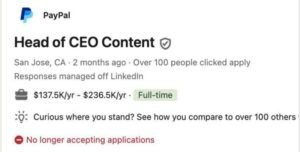
The rise of executive thought leadership and employee-driven content demonstrates this clearly. Roles such as “Head of CEO Content” are increasingly appearing within organisations seeking to build founder visibility strategically rather than incidentally. Meanwhile, brands are beginning to recognise that trust is often built more effectively through recurring human touchpoints than through institutional messaging alone.
The implication is significant: companies that fail to humanise their communication are increasingly disadvantaged in both reach and trust.
Founder-led content remains one of the most effective ways to accelerate trust online.
When founders or executives communicate directly with audiences, they compress multiple brand functions into a single visible identity: authority, vision, credibility, and storytelling. This creates a level of perceived authenticity that traditional brand channels often struggle to replicate.
Consumers connect strongly with personal narratives, particularly those involving ambition, setbacks, lessons, and conviction. Founder-led content allows audiences to associate the company with a recognisable human perspective rather than a faceless institution.
@guzmanygomezau Founder and Co-CEO Steven Marks knows all about a GYG hack! 🔥For a limited time only, score DOUBLE GOMEX points when your order delivery on the GYG App! 💛🖤 No service fee, $5 delivery fee or FREE delivery when you spend $50!
♬ original sound - Guzman y Gomez
Companies such as Guzman y Gomez demonstrate this effectively. Founder and Co-CEO Steven Marks has become closely associated with the company’s public identity, reinforcing the brand’s positioning through visible leadership, strong personal conviction, and highly recognisable communication. Much of the company’s marketing philosophy revolves around maintaining what Marks describes as the “soul of the brand,” with content often prioritising speed, authenticity, and personality over highly polished advertising formats.
Founder-led visibility can create several strategic advantages:
In professional services and B2B industries, executive visibility can also serve as proof of expertise. Firms such as McKinsey & Company regularly position senior partners and practice leaders as public-facing intellectual authorities, reinforcing institutional credibility through individual expertise. Their content strategy often humanises complex business topics by placing experts directly in front of audiences, allowing the firm’s knowledge base to feel more accessible and authoritative simultaneously.
This approach is particularly effective in sectors where purchasing decisions rely heavily on trust and perceived competence.
However, founder-led systems also introduce structural concentration risk.
Over-reliance on a single personality can limit scalability, create succession vulnerabilities, and place significant pressure on executives to continuously produce content alongside operational responsibilities. If a founder steps back from the business, reduces visibility, or exits entirely, the organisation can experience a noticeable decline in audience engagement and brand familiarity.
This can also create valuation concerns in founder-dependent businesses. If brand equity becomes too tightly connected to an individual, the company itself may become harder to separate from the personality attached to it.
There is also the challenge of sustainability. Founders and CEOs are rarely full-time creators. Maintaining consistent, high-performing content while managing business operations can eventually lead to burnout, repetitive messaging, or declining content quality.
As businesses scale, founder-led content alone often becomes difficult to sustain independently.
In response, many organisations are moving toward team-led content systems that distribute visibility across employees, specialists, and internal creators.
Rather than relying on a single executive voice, these companies transform social media into a network of interconnected experts and personalities. Trust becomes distributed rather than centralised.
This model is particularly effective in industries where buyers seek ongoing proof of operational capability, technical knowledge, or cultural relevance. Instead of simply hearing what the company claims, audiences observe how employees think, communicate, and solve problems publicly.
Kinso AI has emerged as a strong example of this approach. Its social presence resembles episodic media programming more than traditional advertising, with team members functioning as recurring audience touchpoints rather than background employees. Instead of concentrating attention solely on a founder or CEO, the broader team becomes part of the brand narrative itself.
This approach changes the role of social media from a promotional channel into an entertainment and community ecosystem. Content output becomes more scalable because visibility is shared across multiple personalities and perspectives rather than concentrated at the executive level alone.
Importantly, team-led content also provides audiences with broader evidence of organisational capability. Buyers are often seeking more than good marketing; they are seeking reassurance that the people inside the company are competent, informed, and aligned with the organisation’s positioning.
This is where distributed expertise becomes strategically valuable.
Similarly, Morning Brew has built a highly recognisable media identity by turning internal staff into recurring personalities across short-form content. The organisation blends journalism, workplace culture, and entertainment into a unified content ecosystem where audiences become attached not only to the content itself, but to the people delivering it.
In one recent social video series discussing Gen Z workplace trends such as “coffee badging,” “quiet quitting,” and “job hugging,” employees discussed viral headlines conversationally rather than formally reporting on them. The result resembled entertainment programming more than traditional publishing.
This style of content does more than report cultural trends; it actively participates in them. By presenting workplace conversations through recognisable personalities, the company transforms passive viewers into emotionally engaged audiences.
In effect, team-led content turns a company from a single social presence into a network of interconnected voices. However, distributed visibility also creates operational complexity.
Without strategic alignment, employee-driven content can quickly become fragmented or inconsistent. Companies pursuing team-led systems must ensure:
There are also cultural considerations. Not every employee wants to become part of a public-facing content strategy, and over-reliance on highly visible team members can create new vulnerabilities if staff leave the organisation.
In some cases, excessive approval processes can also undermine the spontaneity that makes employee-driven content effective in the first place.
For many organisations, the most effective approach will not be founder-led or team-led content independently, but a coordinated hybrid system.
Under this model:
This creates a layered trust architecture where credibility is reinforced across multiple audience touchpoints simultaneously.
Importantly, hybrid systems are also more resilient. Trust is not dependent on a single executive, nor diluted across disconnected employee activity. Instead, the organisation functions as a coordinated network of aligned voices.
This model also allows businesses to match communication styles to audience expectations across different platforms. A founder’s perspective may perform strongly on LinkedIn or podcast appearances, while employee-driven content may resonate more effectively on TikTok, Instagram Reels, or short-form video formats.
The strategic objective is not simply increasing content volume. It is building multiple trust pathways into the organisation.
As algorithms increasingly reward familiarity, expertise, and engagement over polished corporate communication, companies that operationalise distributed trust systems will likely outperform those relying solely on institutional brand messaging.
The broader shift occurring across social media is not simply a change in content style. It reflects a deeper transformation in how audiences evaluate legitimacy online.
Consumers increasingly trust people before institutions. They seek signals of expertise, cultural relevance, transparency, and human presence before making purchasing decisions.
As a result, the companies most likely to succeed on social platforms will not necessarily be the loudest or the most polished. They will be the organisations that build scalable systems for human credibility.
For some businesses, that may involve highly visible founders who become synonymous with the brand itself. For others, it may involve building internal media ecosystems where employees collectively represent the organisation through distributed expertise and personality-driven content.
In many cases, the strongest approach will combine both.
The key is not to imitate another company’s strategy simply because it performs well externally. What works for Guzman y Gomez or Morning Brew may not translate directly to organisations operating in different industries, cultures, or stages of growth.
Instead, companies should focus on identifying:
Ultimately, the competitive advantage will not come from producing more content alone. It will come from understanding how to strategically humanise the organisation in a way that feels authentic, credible, and sustainable over time.
In that environment, social media strategy becomes less about publishing content and more about architecting trust.